
 English
 Japanese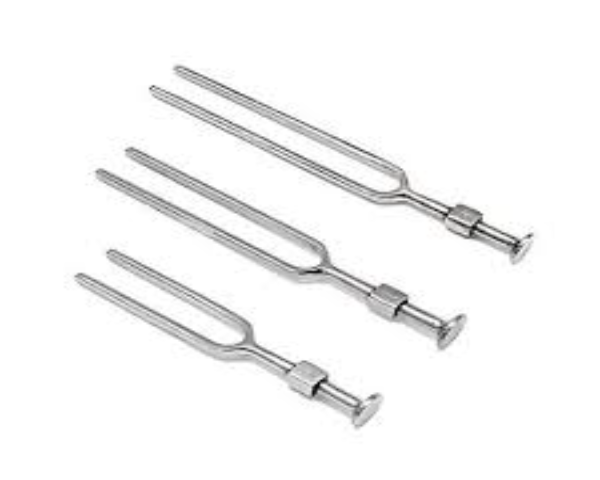
Tuning Fork
A **Tuning Fork** is a diagnostic instrument primarily used in neurology and audiology to assess vibratory sensation and hearing. When struck, it produces a specific pitch (e.g., 128 Hz for vibratory sense, 512 Hz for hearing). In neurological exams, it helps detect peripheral neuropathy by testing the patient's ability to perceive vibrations. In audiology, it's used for basic hearing tests like the Weber and Rinne tests to differentiate between conductive and sensorineural hearing loss. This simple yet versatile tool provides valuable diagnostic information for sensory and auditory functions.
$ 7.00
A **Tuning Fork** is a two-pronged, metal instrument that, when struck, produces a pure musical tone at a specific frequency. In a medical context, it serves as an important **Diagnostics Tool**, primarily used to assess **hearing (audiometry)** and **vibratory sensation (neurology)**. For hearing assessment, tuning forks are used for basic tests like the Weber and Rinne tests to differentiate between conductive and sensorineural hearing loss. The fork is struck and placed on different points of the head or mastoid bone, and the patient reports where they hear the sound. In neurological examinations, a tuning fork (often 128 Hz) is used to test vibratory sensation, which assesses the integrity of the peripheral nerves and dorsal columns of the spinal cord. The vibrating fork is placed on bony prominences (e.g., ankles, wrists), and the patient indicates if they feel the vibration. The tuning fork, despite its simplicity, provides valuable diagnostic information, making it a reliable and cost-effective instrument in both otolaryngology and neurology for rapid screening and assessment.
-
Shiori Suzuki
持ち運びにも便利です。
-
Liam Bell
Well-made and accurate for neurological assessments.
-
Yua Takahashi
精密な診断に欠かせません。
-
Ava Wilson
The Tuning Fork produces a clear, sustained tone.
-
Tsubasa Sato
音叉は、聴力検査に正確な振動を与えます。